Artist
Victor Vasarely
Painter and master of optical art
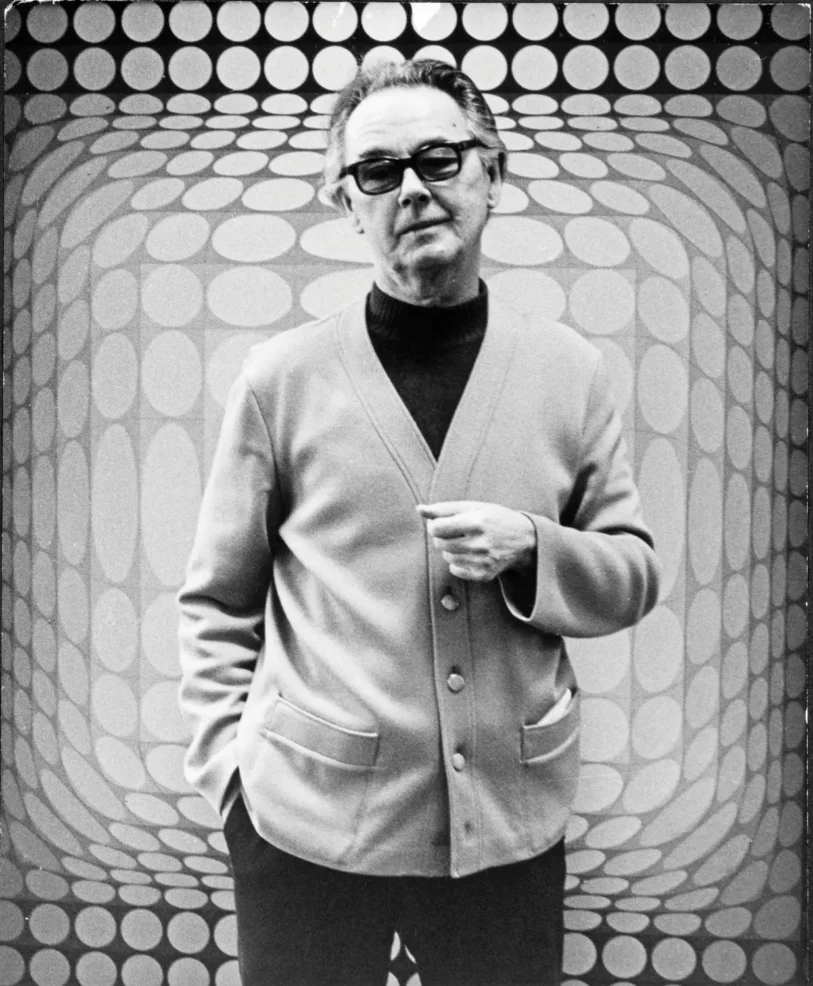
Victor Vasarely (Pécs, Hungary, 1906 – Paris, 1997) is widely regarded as the father of Op art and one of the most influential figures in twentieth-century geometric abstract art. He began studying medicine in Budapest before abandoning the degree to pursue painting, and between 1928 and 1929 enrolled at the Mühely — the Hungarian Bauhaus — where he trained in applied graphic arts, photographic design, and abstract art. There he also developed a conviction that art should be less individualistic and more oriented towards the collective.
In 1930 he moved to Paris, where he worked as a graphic designer and poster artist while building his own language of geometric abstraction: a system based on a minimum of forms and colours capable of generating effects of depth, perspective, and movement. In 1938 he made Zebras, considered the first work of Op art. Until 1960 he worked almost exclusively in black and white, constructing optical illusions from the tension between two contrasting coloured forms; from that year onwards, colour entered his work permanently.
In 1955 the Galerie Denise René presented his work alongside that of Duchamp, Man Ray, and Calder in the exhibition that would mark the beginning of kinetic art as an international movement. That same year he published his Yellow Manifesto, in which he set out the concept of kinetic plasticity and argued that the viewer is, in fact, the true author of the work. His international reputation was cemented in 1965 with his participation in The Responsive Eye (MoMA, New York), after which the press definitively crowned him the inventor of optical art. In 1971 he established the Vasarely Foundation, based in Aix-en-Provence, to preserve and promote his legacy.